跳到主要內容

JWST deployments challenge


 Sunshield 

107 pins or membrane release (non-explosive) devices, consists of springs and magnets


These pins were designed to keep all 5 layers of the sunshield tidy for launch. With the completion of this deployment, all of them have now been successfully released.
 

NASA

the unfolding is similar to how parachute unfold ( by wind), or sails rigging on a sail boat, via strings or ropes.

The unfolding and tensioning of the sunshield involved 139 of Webb’s 178 release mechanisms, 70 hinge assemblies, eight deployment motors, roughly 400 pulleys, and 90 individual cables totaling roughly one quarter of a mile in length. The team also paused deployment operations for a day to work on optimizing Webb’s power systems and tensioning motors, to ensure Webb was in prime condition before beginning the major work of sunshield tensioning.

11:59 a.m. EST Tuesday(4 Jan 2022), the sunshield was fully tensioned and secured into position, marking the completion of the sunshield deployment

 Temperatures on the Sun/hot side of the sunshield will reach (design spec) a maximum of approximately 383K or approximately 230 degrees F (110 degrees C) and on the cold mirror/instruments side of the sunshield, a minimum of approximately 36K or around -394 degrees F(-247 degrees C)

Scientific payload of JWST:

NIRCam

NIRSpec

MIRI

FGS/NIRISS

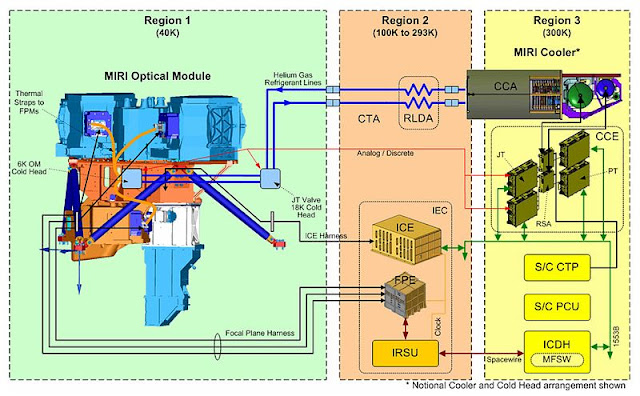
The (active) cooling system for MIRI includes a Pulse Tube precooler and a Joule-Thomson Loop heat exchanger. This allows MIRI to be cooled down to a temperature of 7 kelvins during operations in space.


Weak lens, wavefront sensing

Optical design status

ellipsoidal primary, hyperboloidal secondary, and ellipsoidal tertiary

Secondary mirror:

NASA declined to tell us which company made the blurred-out part, saying that information is an International Traffic in Arms Regulations issue. (More on this jargon in a moment.)

However, we know Northrop Grumman is the prime contractor that designed the spacecraft, and Ball Aerospace built the secondary mirror.

Lon Rains, a Northrop Grumman representative, declined to comment further and asked us to direct our questions to NASA. Ball Aerospace did not immediately respond.

Why is the back of a mirror on a taxpayer-funded scientific observatory considered an "arm" that must be regulated?


Probably because of spy satellites.

After all, if your telescope can see as sharply as Hubble, yet resolve objects 10 to 100 times dimmer — as JWST should be able to do — that could be useful for peering down at human activity on Earth. And the US government wants to maintain any edge it can over the militaries of countries like China and Russia.

Third mirror:

Stationery

Corrects astigmatism and field curvature.

In this YouTube video (02:05), it's bit misleading of role of tertiary mirror

The fine steering mirror. It is hexagonal segmented, U guess it works as baffle to restrict stray lights

Beginning about 77 days after launch, MIRI’s cryocooler will spend 19 days lowering the temperature of the instrument’s detectors to less than 7 kelvins.


HST ACS vs JWST NIRCAM

Cryo testing

JWST PSF   

Spied library

Two opd

scitechdaily 

Business insider 

留言

這個網誌中的熱門文章

CMOS sensor trends and astrophotography, from amateur astronomers perspective

Nowadays, even in low light conditions, digital camera can quality pictures with higher ISO, noise and hot pixels have been gradually reduced. Sony has introduced back illumination process for consumer market. Sony BSI sensors evolved  from Exmor to now Exmor RS( stacked) technology. This stacked technology allows further chip size reduction, which has strong demands in smartphone camera market. Digital astrophotography is also benefited from such advances, utilising Back Side Illumination technology Exmor: Within the CMOS sensor, it outputs low-noise digital signals by "on-chip column AD conversion" and "dual noise reduction" to suppress noise in the first half of the process In low light conditions, when a wide aperture is desirable to collect as much light as possible. At apertures wider than f/2.0, back-illuminated Exmor R sensors are significantly more efficient at collecting light than conventional, front-illuminated sensor...

ultrafast rendezvous to ISS

    14 Oct 2020,  being the first to use a new “ultrafast” rendezvous” scheme with the ISS. Following a flawless ascent to the correct orbit, Soyuz 2 .1a , Soyuz MS-17 caught up with the orbiting laboratory in only two orbits (three hours), halving the time it takes for crew to get to the Station.   The three space travelers of the Soyuz MS-17 mission launched on a six-month mission the International Space Station.  previous 3/4 orbit rendezvous: Soyuz MS-16 4 orbit rendezvous A three-orbit profile was deemed possible without major flight design changes after inauguration of the Soyuz 2-1A rocket that provides a much higher orbit injection accuracy than its predecessors and would allow the two correction maneuvers on Orbit #2 to be eliminated while the Automated Rendezvous Phase would still remain untouched. The deletion of the Orbit #2 maneuvers was expected to slightly tighten the already restrictive phase angle window from and upper limit of 30-35° to 25-28°...

Scythians 斯泰基 塞種 西古提人

900 BC - 200 AD British museum   Tomb of scythe prince, Buktarma valley, 1200 masl, Google map Herodotus   絲路上的帝國 Biblegeography   哥羅西書 3:11  在此並不分希利尼人、猶太人、受割禮的、未受割禮的、化外人、 西古提人 、為奴的、自主的.惟有基督是包括一切、又住在各人之內。 塞種 塞迦  saka 史記漢書 西域傳: 塞種  ctext 昔匈奴破大月氏,大月氏西君大夏,而塞王南君罽賓。塞種分散,往往為數國。自疏勒以西北,休循、捐毒之屬,皆故 塞種 也。 匈奴列傳 Ctext :塞王 《史記》在《大宛列傳》與《匈奴列傳》中, 詳細 記錄了中亞至天山一帶的塞種(塞王、塞地)狀況。例如,文中記載了月氏西破走塞王,導致塞人南遷越過懸度(今帕米爾高原及克什米爾一帶) Baike Genetic history   Genetics  Nih griffin  ? Scytho-Siberian  world 塞迦 saka  wiki Disappeared? Sarmatians ( 薩爾馬泰 , 奄蔡 史記 ,  Aorsi )and goths YouTube