跳到主要內容

Safety net防墮網

 Anchor point 

Anchor points

Safety nets are attached with tie ropes or karabiners to the supporting structure or to specifically-designed anchor points on the structure.

Based on a maximum fall height of 6 metres and an assumed load angle of 45° to the horizontal, each anchor point should have a 6 kN minimum load-carrying capacity– see Figure 10. The combined load-carrying capacity of the supporting structure applied over three adjacent anchor points should be at least 4 kN, 6 kN, 4 kN.
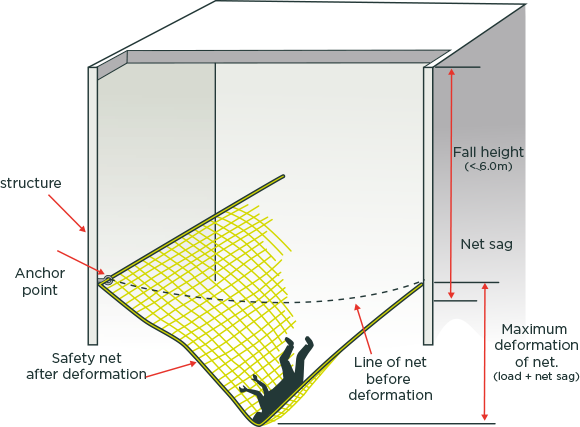
[image] Diagram showing roof worker falling into a safety net with minimum load-carrying capacity
Figure 10: Minimum load-carrying capacity of anchor points.

The maximum distance between anchor points according to BS EN 1263-2 is 2.5 metres but WorkSafe NZ recommends installing anchor points at between 1.5 and 2.0 metre centres.

According to the standard EN 1263-2, the net should be suspended with ropes. When doing so, pay attention to:

  • fixed suspension points at maximum distance of 2,50 metres
  • resistance of each suspension point to a load of at least 6 kN at an angle of 45°
  • advice for a max. distance of 100 mm between the edge of the net and the supporting structure
  • a minimum tensile strength of 30 kN (single rope) or 15 kN (double rope)
  • the securing of rope ends to prevent fraying
  • a containment of the edge rope of the net
  • use of a self-locking knot, such as a clove hitch
  • sufficient distance without obstacles under the net, for the deformation during a possible impact of falling persons

Installation:


Tips from concretefastener


Do. For M10 bolt:

Minimum Embedment depth:

40mm

Hole be 12 mm(1/2 inch) deeper than bolt

TSB M10 w/ hook

Option A:

Using M10 drill bit, hole too tight, bolt sleeve easily deform when hammering. Sometimes bolt head also deform

Need at least 40 hits to get the bolt in.

bolt without sleeve. Expansion cone / Nut need to screw in 5 to 10mm. Hammer until  thread 5 to 10mm protruding, tighten with screwdriver or similar.

Option B:

Using M11 drill bit, tighten the bolt expansion cone, as the left bolt. Hammer as normal

Tighten with screwdriver or similar, by rotating 7 to 10 turns


How to remove anchor:


Option C:

M12 drill bit. Too loose. Not suitable 

Reference:

 Worksafe nz

Hsewebsite

Duranet

留言

這個網誌中的熱門文章

Scythians 斯泰基 塞種 西古提人

900 BC - 200 AD British museum   Tomb of scythe prince, Buktarma valley, 1200 masl, Google map Herodotus   絲路上的帝國 Biblegeography   哥羅西書 3:11  在此並不分希利尼人、猶太人、受割禮的、未受割禮的、化外人、 西古提人 、為奴的、自主的.惟有基督是包括一切、又住在各人之內。 塞種 塞迦  saka 史記漢書 西域傳: 塞種  ctext 昔匈奴破大月氏,大月氏西君大夏,而塞王南君罽賓。塞種分散,往往為數國。自疏勒以西北,休循、捐毒之屬,皆故 塞種 也。 匈奴列傳 Ctext :塞王 《史記》在《大宛列傳》與《匈奴列傳》中, 詳細 記錄了中亞至天山一帶的塞種(塞王、塞地)狀況。例如,文中記載了月氏西破走塞王,導致塞人南遷越過懸度(今帕米爾高原及克什米爾一帶) Baike Genetic history   Genetics  Nih griffin  ? Scytho-Siberian  world 塞迦 saka  wiki Disappeared? Sarmatians ( 薩爾馬泰 , 奄蔡 史記 ,  Aorsi )and goths YouTube  

calculate pH of phosphoric acid

Question: adding 1/4 teaspoon of 10% phosphoric acid  to 19 litres of water, what will be the pH? Let's go through the calculations step by step. Step 1. Convert mass ( or volume) of 10% phosphoric acid to mole per litre ( mol/L) The above calculation shows that 1/4 tsp of H3PO4 acid is 6.97e-5 mol/L Step 2. Input this value to BATE (or other app) to calculate pH The answer: pH = 4.16, ie too acidic !? If you use pipette instead of teaspoon,  1 drop = 0.05ml. So 1/4 TSP means roughly 25 drops If you actually aim for pH 5.6 (which is optimum pH for mashing), conc will be 2.51 e-6, or 1/100 tsp , 0.044 ml, roughly 1 drop Let's roll back a bit. From  recipes of   BarleyWine , summer rye , hefe Gordon Strong suggested to use 1/4 teaspoon of 10% phosphoric acid, which is targeting pH of 5.5..... Discussion on  homebrewtalk  forum. However using online BF water calc , Sparge pH would be 4.6. but he also added 1 tsp of CaCl2. 2H20. Mash pH change from 5.7 t...

ES8311 and ES8388 codec IC

ES8388 audio codec module is one of the audio codec modules available that is supported by ESP32 and official ESP-ADF releases. The ES8388 module lets you have: Stereo microphone and line input Stereo headphone and line out Up to 96 kHz 24 bpp high quality audio This module is compatible with all MCUs that have I2C and I2S ports (like ESP32, ESP8266, STM32, i.MX6, Raspberry Pi, etc) ES8311 Maxgerhardt github PCBartist twblogs ESP32-A1S  (limited stock)Audio codec AC101 or ES8388 built-in. NB the pinouts and firmware are different! Arduino - ESP31-A1S instructable Phil Schatzmann and his github   Simple A2DP thaaraak github on ESP32-A1S github of Yveaux and  Marcel-licence ESP ADF   example:  Logitech PiCorePlayer squeeze lite squeezebox forum   ESP32-Audio-kit  (from AI thinker) based on ESP32-A1S, is simple and small. But upgrade-ability seems limited  Alex John Talbert mixer equalizer: can this be used as simple equalizer? how about proces...